

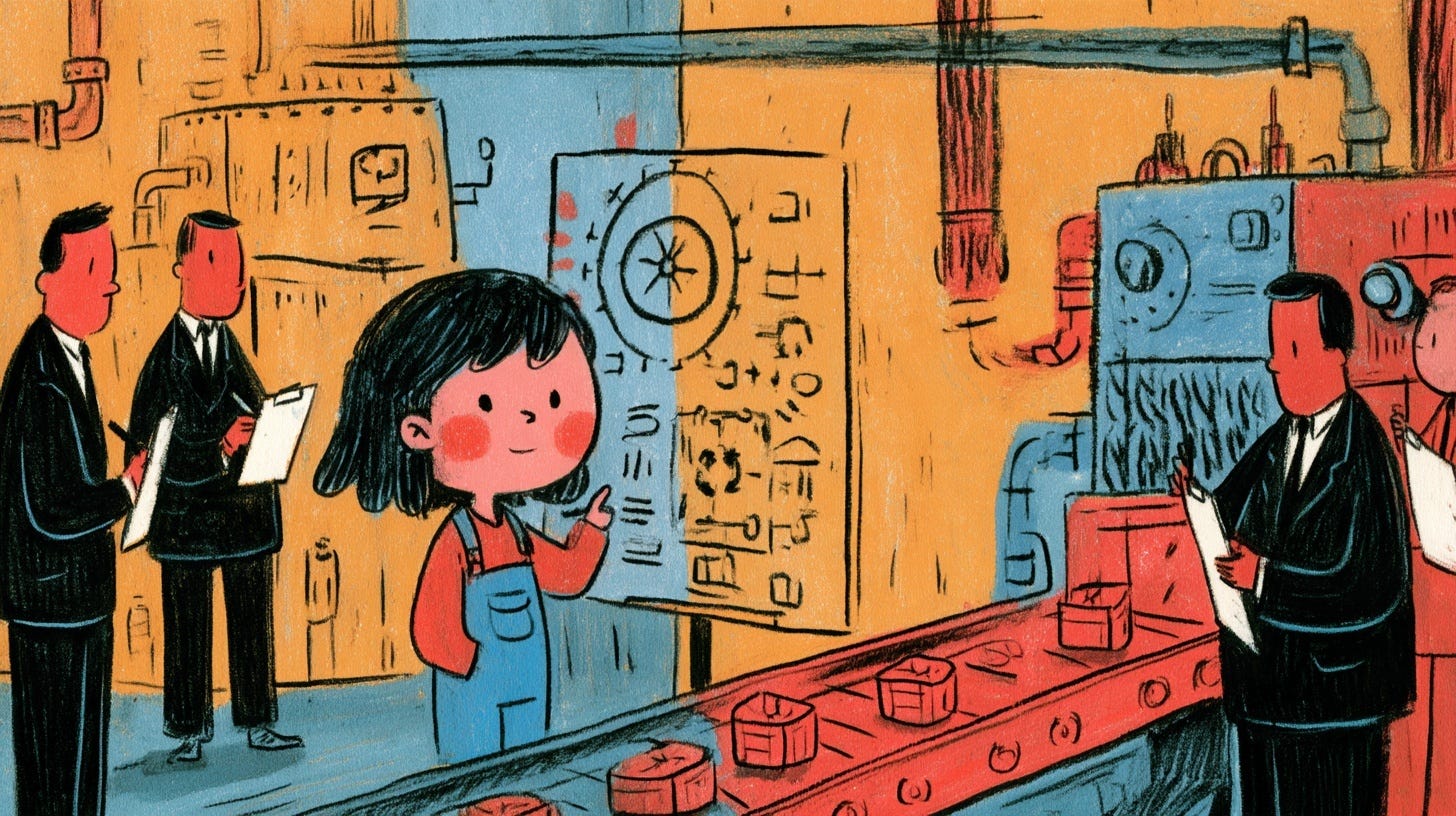
Our jobs have turned into the place where we’re told what to do: show up and follow orders. That was the finding of the latest Skills and Employment Survey (SES) the long-running study of working life in Britain.
When asked, only a third of UK workers say have discretion over how they do their jobs, a number that has dropped from two-thirds three decades ago.

When we hear this it’s hard not to think of the two other issues of contemporary work that have come to define the era: low engagement and low productivity. The latest Gallup survey reports that workplace engagement lingers at 10%. It’s always a difficult stat to quote, most organisations subscribe to a pulse tool that will tell them that they’re own engagement is something closer to 70 or 80%. ‘Low engagement is for other companies, it’s not our problem,’ they conclude. Meanwhile their workforce sits on back-to-back Teams calls, with glazed eyes and deadened souls.
Professor Alan Felstead, one of the leads of the research, was clear when I asked him to explain the disappearance of workplace agency. He’s pretty clear that we’ve created a version of work where people feel like they know how to do their job best, but they’re not permitted to. The end result is an experience of work that is disempowered and disengaged.
The SES survey is a gold standard piece of work, that has been running for decades. It involves face-to-face interviews across the country. Through his involvement Felstead has become clear that the productivity crisis is directly related to a lack of workplace agency. As he says, ‘The more task discretion people have, the more productive they are at work.’ We’ve created a version of work where we don’t allow the worker on the frontline to choose how to get their job done. ‘People make the difference,’ he tells me, ‘and they should be allowed to make that difference, because it’s good for productivity and it’s good for their mental health and wellbeing.’
It has an adjacency with comments from the UK Prime Minister, Andy Burnham, this week suggesting that the secret to growth is devolving decisions down to ‘allow growth in every postcode’. Felstead says ‘the small-ticket items matter most’ - things that feel specific to each person doing their job has the greatest uplift on their sense of autonomy.
What strikes Felstead is the fact that workers are highly forthcoming when it comes to saying how they could improve their roles. ‘When people are asked [how to improve their job], they’re more than happy to input and often they input a lot.’
The challenge for many organisations is that they don’t necessarily want to hear the inputs from frontline workers, maybe they believe that a new system is too bureaucratic or new computer software is unsuited to the job. Head office is determined to implement a plan which feels inappropriate for those doing the job. It’s why these workers often don’t believe the company culture belongs to them.
The idea that workplace autonomy might be the driver of results isn’t a new idea. One of the most important psychologists of the last fifty years, Martin Seligman, published a new book on the topic last week. Agency sees Seligman laying out his conviction that human agency is the propulsive force of advancement. As he says in the book,
‘Agency drives action. This psychological state is a driver of human progress over history. When it is present, progress occurs. When it is absent, stagnation occurs’
It’s worth thinking about a recent Teams call and reflecting on how much agency you witnessed from the quiet corners of the call. One organisation who has recognised that there is a value in empowerment is Octopus Energy. When I spoke to their CEO, Greg Jackson last summer he told me that the firm didn’t really have their culture codified, other than they set out to give everyone autonomy in their roles. His job was to let his workers do what they believed was the best version of their job. (Listen here: podcast on Octopus Energy
Felstead has advice for any manager. He says despite what we might hear, most of us don’t think our jobs are ‘bullshit jobs’, ‘they’re an important part of our lives’ but ‘the main message is: give employees greater voice. Listen to them more’.
Listen to my discussion with Alan Felstead: website, Apple, Spotify
Check out Alan’s workplace quiz: How Good Is My Job
Like this? I gave a talk on similar themes in the summer:

I had a remarkable experience this week of a recruiter approaching me for a very well-paid advisory position (at an unnamed firm). I sent over my credentials and details. There was definitely a spring in my step, it’s always nice to open the inbox to good news. The recruiter came back with a 7-point savaging of my submission, and insisted that I should use their partner company to urgently get my application into a more refined state.
This would of course be a worthwhile investment, to land such a lucrative role.
The only issue was that their email was glaringly AI-generated. (Backed up when Pangram, which I tend to trust, rated it as 100% artificial).
I pushed back, suggesting their email felt very sloppy when they were offering to refine my content, rather than turn it into something more generic. They immediately went quiet.
I’m pretty sure that there was no job. It was just a racket to get money out of eager candidates.
The Washington Post reports that job scams like this are getting more and more sophisticated. Their simple advice: beware anything that seems too good to be true.
Jarring Wired article about AI co-workers starting to join some organisations’ Slack channels
Barclays softened its RTO plan after vocal employee backlash.
Review of a talk I gave to the APG last week. Hoping to upload a video of it in the next few days.
Former podcast guest Tom Kegode, who played a hands-on role in Lloyds Bank’s cultural transformation, has started publishing a book week-by-week. Worth getting in early.