

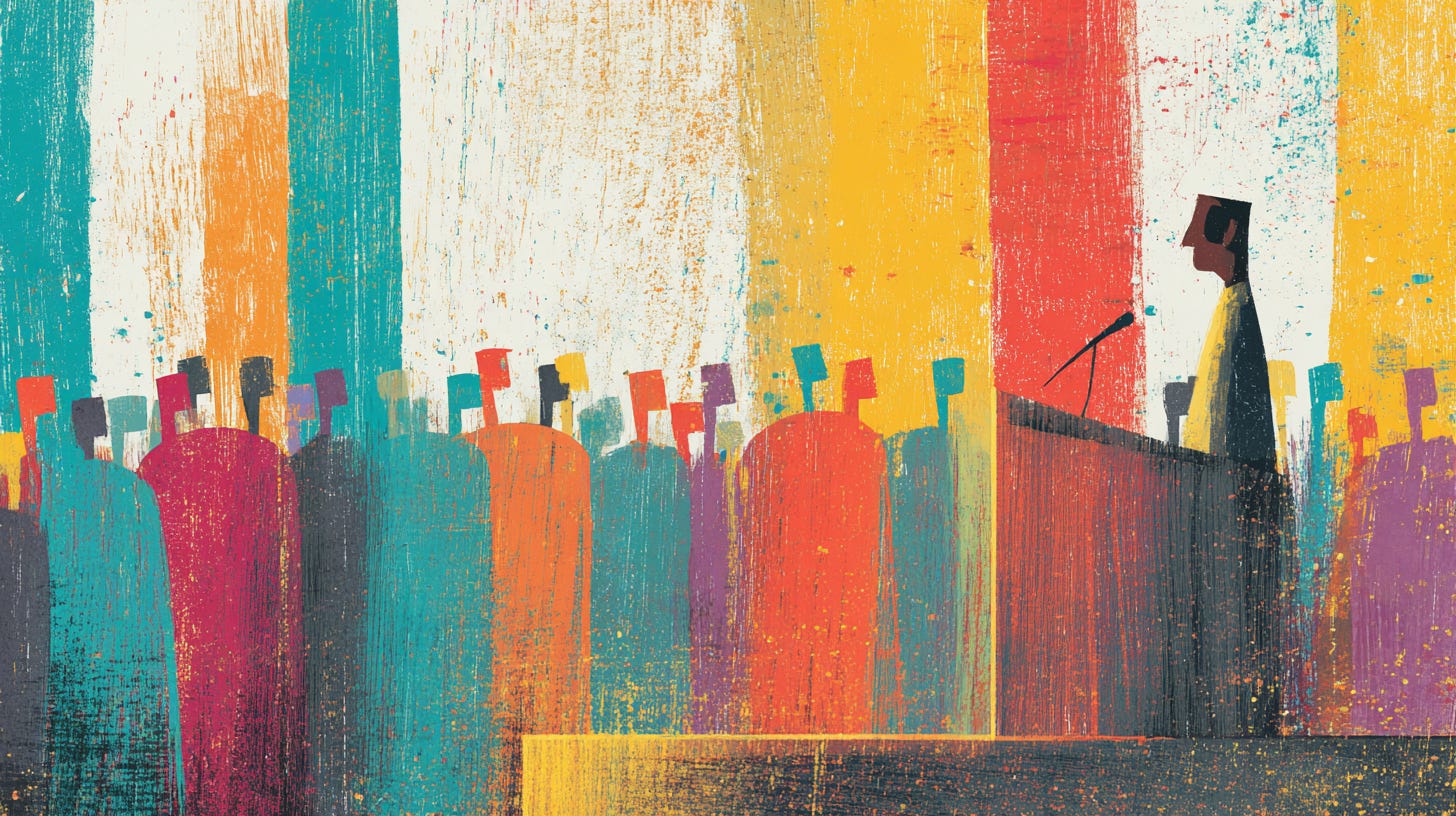
One of the themes we’ve explored over the last few months is the idea that most messages inside organisations are received by weary, perhaps cynical audiences.
This is a topic that I returned to this week with a conversation with Professor Benjamin Laker from Henley Business School. I love Benjamin’s work, his article on Meeting Free Days is probably the piece of research I've shared the most in the last 5 years and it’s no surprise that the esteem of his work has led to him working with huge organisations and governments on both sides of the Atlantic.
Last autumn Laker and colleagues published an article in Harvard Business Review reflecting on the failures of culture change efforts inside organisations. (I first wrote about it here). The article featured research finding that 72% of formal culture change initiatives inside organisations showed ‘no meaningful improvement in employee trust, engagement, or retention’.
My conversation with Professor Laker went further into this. ‘Culture isn’t a campaign,’ he explained to me, ‘the more you talk about culture, the less people believe you’.
In many firms he explained, ‘You are already quite up against it because of previous initiatives’. The workforce collectively says, ‘Here we go again. A town hall meeting. The slogan is changing. We’ve done this before. Nothing changes as a result.’
This is especially true because frequently employees observe contradictions between the words management are saying and the actions of the leaders. In Laker’s research he found that ‘59% [of employees] told us that senior leadership actions contradict stated values at least weekly’. That might be announcing cost savings but flying business class themselves, declaring high bars for behaviour that no one at the top actually meets, the list goes on.
So what’s the answer? Not less communication, but a different sequence. Hold back on treating things like campaigns. Nail the delivery first, then offer explanation.
The reflection that we live in a sceptical world is a vital lens of any of us right now. Knowing that more trust will be gained by doing things rather than talking about them is vital. There’s an important paradox at the heart of what Laker unveils is that communication alone isn’t enough. Flashy new values and a slogan won’t change behaviour. But that isn’t to undermine the importance of communication. Leaders need to be the explainers in chief.
The clearest example of this I've seen recently is in New York. Mamdani inherited the assumption that most people don't believe politicians or trust that things can change. When Manhattan was hit with 20 inches of snow this week, his team told him they didn't have the people to clear it. His response? We’re a city of 8 million people, people isn’t the problem here, a system to organise them is. The snow was cleared in two days by paying $17 to $30 per hour to a citizens’ army of willing workers.
The communication followed the action, not the other way around.
Delivery first, then explanation.
Laker’s research reflects exactly this logic: when senior leaders altered their behaviour - changing how they ran meetings, responded to challenges or made decisions, trust scores increased by 26%. Not from a new values framework. From doing things differently.
There’s been a lot of discussion that in the era of Mamdani, Farage and, maybe, Trump the role of a politician is to think like an influencer, to communicate memorably and frequently. The best politicians have always been create communicators, it’s just today that looks like someone who captures your attention on Reels or TikTok rather than giving a one hour speech.
To my mind, leaders need to think about what they can learn from this when it comes to their own role as Explainer in Chief. The more important lesson for leaders isn't about format, it's about sequence. Act first, show that change is happening, then explain what you did and why. That's what makes people believe you and buy into you.
Listen to the interview:
===ad===
The Experience Your Team Didn’t Know It Was Missing!

At artspace we specialise in using the power of art to invigorate your team through unique, creative workshops. Our art psychotherapists create bespoke, transformational spaces, unlocking creativity, connection and a whole new way of seeing things. No art skills required. Curious to try something different? We’d love to chat – hello@artspaceartherapy.co.uk or visit artspaceartherapy.co.uk.
Requesting Boast Mode: Tell Me About Your Special Culture
Do you work in a fantastic workplace culture? Is there something that you’ve done (or benefitted from) that has helped energise your team dynamic? Or has it turned around a bad experience? I’d love to hear from you

The US is drifting further and further away from the norms of the rest of the world. Paid maternity Leave in the US already sits at the bottom of the league table. Here Professor Scott Galloway (who positions himself as progressive) tells new fathers not to take paternity leave from their firms
The Times reports that the government is considering making it a legal right to do some work from home
I’m deliberately trying to avoid talking too much about AI and work because its so extensively covered elsewhere. Of course you might laugh when you see that tech boss declare ‘all office work will be automated in 18 months’ and then realise the guy saying it works at the company that makes Teams and Outlook
But least once a week someone tells me they’ve been dazzled with what an AI tool has just done for them. It largely suggests that most people aren’t throwing challenging tasks in the direction of the premium AI products. For those people I say: try something big this week. Ethan Mollick’s guide of which AI tool to use is here. (For me I’d suggest either Gemini or Anthropic’s Claude are the best two to play around with - Gemini for speed of response and extent of research, Claude has the best written language that don’t seem as Slop-afflicted as Chat GPT)
I was moved by this TikTok about someone’s friend finally recognising the exhaustion of work. (Worth watching rather than reading). The poster’s friend tells here: ‘I’m so sorry I gave you such a hard time for being unavailable for so long… There’s something about freedom of thought here, I feel like I felt my brain change walking into the building… like a comatose feelings’


Absolutely agree; talking culture to death often buries the practical steps needed to build it. What winds me up most is senior leaders relying on announcements, slogans, or campaigns to change it: they need to set the tone through their own behaviour and hold the line on anyone stepping outside the standards. Real culture forms right there.
Love your work Bruce.