


Last year I managed to sit at the back of a huge company’s internal conference. While viewing a venue I was allowed to sit in on a software organisation’s annual gathering to rally the troops, reward success and get the team on track.
These things generally follow a standard format: some vast screens, a big audience of excitable employees and some impressively slick presentations. Big pop music hooks welcome speakers to the stage.
What stood out was the presentation by one of the senior leadership team. It was certainly being discussed in quiet corners of the bar afterwards. He started a story about his childhood and some of the rough bumps in the road that he’d experienced. Soon he was bridging into the challenges of his life today and how stress had taken a toll on his mental health. He steered clear of ticking the ‘ok not to be ok’ box on the bingo cards but only just. His lip went at one point. It was quite the show.
The whole thing was straight out of the Brene Brown playbook. Brown encourages leaders to ‘rumble with vulnerability’ when telling their stories. To put it all out there showing who they really are. I'll be totally transparent on the issue with this - Americans are different to people from anywhere else in the world. (I mean this with love btw, my partner is Lebanese American). I’m not sure the vulnerability thing works perfectly out of the box.
This is no slight to Brene Brown. Her first TED Talk on vulnerability (15 years ago!) was a masterclass. I’ve witnessed firsthand how such testimonies can connect with US audiences. They can be seen as brave, inspirationally breaking down hierarchical barriers. With my own eyes I’ve seen how an earnest, deeply personal, even occasionally tearful talk can charm an audience. But these things don’t land the same way everywhere else.
For the UK conference audience that day the whole thing was just an exercise in cringe. I can’t even begin to imagine what the Dutch would have made of it. It just struck me the same rules are not international, the euphoric appreciation of American audiences, outside the US is replaced by a sea of people wishing they were anywhere else. Praying that they get an emergency call that a distant relative has died so they can go home early.
As far as the coffee bar chat that afternoon went they’d have given anything to not have to be there. I want to suggest that this isn’t a passing bout of cynicism, but that there’s reason to think things are getting worse.
This week Edelman published their annual Trust Barometer. Edelman’s commentary suggests that we’ve entered an era of isolarity, ‘where people are unwilling to be with people whose views (or sources of information) differ to our own’. Accompanying it a huge disappearance of optimism (only 15% of people think their families will be better off in the future).
Edelman see this cynicism is being expressed as a rejection of AI, a rejection of multinational brands and hostility towards workplace colleagues who disagree with us.
In the face of this cynicism is no longer seen as being a tool of critical thinking (scepticism), now it’s felt to be a defence mechanism against a world that feels increasingly performative.
Cynicism makes us view these gestures as an act. This performative vulnerability can feel invasive. At best like a parlour trick where a manager who has read a book is trying some schtick out on the workforce, at worst it’s manipulative.
Why, we ask ourselves, is this guy suddenly telling us about his mental health challenges? Our default setting is to disbelieve what we’re being told, and to question why we’re being told it.
Societally we see evidence that this goes way beyond the workplace. The last five British Prime Ministers have each been successively the least popular Prime Minister of all time. (No one cares about reasons, the data says people don’t trust what we’re being told. Also, no idea how David Cameron escaped scot-free from that one).
The crisis of trust should concern all of us. The cynicism documented in the Edelman report isn’t irrational. There’s a widespread sense that people feel let down by people in power and the institutions they represent. Talking about the Beckham feud this week Marina Hyde highlighted the fact that ‘authentic’ communication is now a content category, manufactured on demand. Like the emotional keynote, we should recognise that the power of what we think we’re achieving might not escape the cringe of the people receiving it.

I’ve commented before how tribal I find the AI debate. Personally, I can definitely see both sides of where we are right now. But to enable you to pick your lane, here’s fan service for both sides:
Anti-AI take of the week: “Recently, senior executives at Salesforce have admitted, both internally and publicly, that they massively overestimated AI’s capabilities. They have found that AI simply can’t cope with the complex nature of customer service and totally fails at nuanced issues, escalations, and long-tail customer problems. They even say that it has caused a marked decline in service quality and far more complaints”. This post suggests that over claims on AI’s capabilities are starting to cause an embarrassing reverse ferret
Pro-AI take of the week: the positive buzz around Claude Code and Claude Cowork are ongoing. Some examples below and they are hard to argue with:
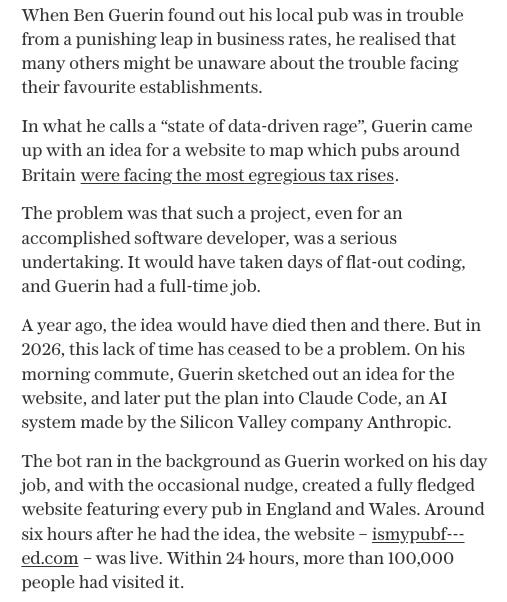
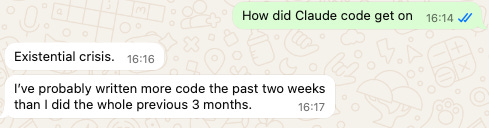
Telegraph article (archive version), website. Elsewhere Google’s Learn Your Way brings Notebook LLM to revision - students using it scored 78% (vs 67%) on retention tests. This interactive map tells you the cheapest Lime bike journey to avoid paying money for standing at traffic lights - it’s entirely built in Claude Code. I asked my friend (a very senior developer, who was quite sceptical on AI until Christmas) his take:
On 14th May I’m giving a new talk ‘How Boring Ruined Work’ at the Watch Me Think conference, I’ve not written it yet but I’ve got high hopes
A post from Reddit about someone being performance managed for not working out of hours. (Warning: most Reddit content needs a least one chinny-reckon stroke of the chin)


'Every day our employees are faced with 25 moments of truth that shape what customers think of our service.
That's 125 moments a week.
That's 500 moments of truth a month.
We've got 14,000 frontline staff.
That's 80 million moments of truth every year'.
I loved this discussion with Kevin Green from First Bus about building customer happiness on a foundation of better workplace culture.
Listen: website / Apple / Spotify
As someone who became one of the original paid-up members of the Brene Brown Vulnerability Fan Club, I totally, totally agree that it is not entirely transferable from American culture to others! In saying that, I will also call on one of her teachings, which is that vulnerability isn't just letting everything hang out there for everyone to see. The way I describe it to people I work with is being genuine and real enough so that people can *know* what to expect from me, not *wonder* what to expect from me. That means just getting to know each other a little bit better. I think in leadership, it's something to be admired, but it is definitely nuanced depending on cultural context.
I too am a follower and a fan of the Edelman Trust Barometer. It's been giving us great macro data for a number of years now, so the lack of trust in institutions is hardly surprising to me.
What is concerning, though, Bruce, is that people want to hang out with like-minded people all the time, so we're creating these bubbles of sameness. I think what the danger is here is that actively seeking out folks with alternate views to your own, really listening and then respectfully debating (not to convince but respectfully debating) those points of view, is sadly an art that's becoming lost.
I'm from Germany - so I am totally with you on the blurring line between vulnerability and cringe. And yet - what IF we were all a bit more vulnerable and put our professionals masks off more often? The good part of being vulnerable is you understand better what moves people, what they value and ultimately whether you want to get to know them better. You don't get this from the typical German watercooler conversation: "Wie geht's?" "Muss". End of discussion.