

We’ve known for a long-time how important workplace friendships are for employee retention, customer satisfaction and workforce happiness. But a new report from KPMG is a powerful indicator that workplace bonds dial up the emotions on all aspects of work - including the stress.
‘As AI increasingly handles more complex tasks, the cognitive and emotional demands of people in the workplace are only increasing,’ says Sandy Torchia from KPMG commenting on the firm’s latest research into workplace friendships. The report found that workers with strong connections at work were the most engaged employees, with 49% saying they were ‘always engaged’. But they also reported the biggest emotional swings. A workplace with strong employee connections is going to find job cuts significantly more emotional that those where workers don’t fraternise together.
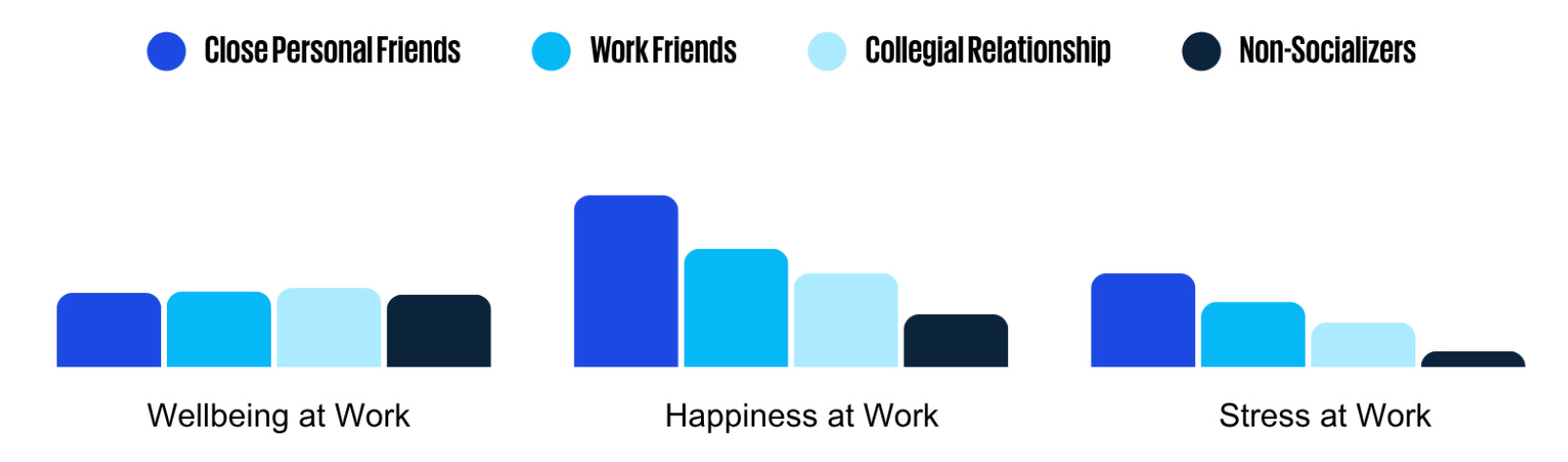
The benefits of having close personal friends at work went beyond the feelgood factor that saw strong friendships being perceived to be worth a 20% salary premium. People with close friendships at work were far more likely to say they were focussed on skill development (87% vs 52% of those who don’t socialise at work). They were also more likely to trust their company and also partipate in using AI tools.
Those with workplace connections were way more more likely to say their work mattered to them (84%), compared to non-socialisers (62%). This is about group identity in action, when we feel part of something and see colleagues as mattering to us, we become more committed to the job in hand.
But the cautionary note is worth considering. Recent history has seen many organisations having to cut jobs, and that context saw employee connection serving to turn the dial up on all workplace emotions. Those with friends had the highest happiness scores (82%), highest excitement scores (65%) but also high stress figures (63%) and elevated sadness (47%).
67% of workers said that a culture that allowed them to have close friendships was an important reason to choose to stay with their current employer. These employees were twice as likely to say they were very happy with their jobs.
The research is worth considering alongside the study below in Top Reads that suggests detachment at work is the cause of burnout. We need to feel connected at work, but employers should be aware that we can’t pick and choose when the emotional intensity counts.
Workplace connection is an antidote to burnout and an engine of AI adoption, but it comes as part of a package. We can’t take the productivity gains, the increased loyalty and effort, but then be frustrated when connection amplifies the stress of job cuts and stress. Team cohesion, group identity, is a powerful driver of workplace productivity but it comes at the expense that organisations need to be seen to be doing the right thing for the tribe.
Read more: KPMG - Friends at Work 2026

Quiet quitting is about detachment not burnout, that’s the finding of a new piece of research out of the US. The study looked at explanations for the phenomenon and found it reflected a shift in workers’ attitudes, going slow because they felt work was an unfulfilling part of their lives.
The quiet quitters weren’t those with low status jobs, in fact those who were allowed hybrid working were more likely to check out than those on site all week.
Worryingly for leaders seeking a fix, the researchers suggest that managers won’t find easy answers to quiet quitting, the trend reflects a broader disaffection with work and society.
This has echoes with Edelman’s Trust Barometer, organisations seeking to find a way forward probably have to think about gradually building trust and differentiating themselves versus the outside world. No quick fixes here.
‘Business should be a multiplayer game’, says Rory Sutherland, but technology has made it a single player game. The Telegraph reports that 17% of Brits go through the day without talking to anyone and 40% of us feel lonely at work. (Alternate link).
AI-caused Disconnection: coming soon to a workplace near you. MIT published an assessment of what AI is doing to students. Study groups are vanishing, written assignments no longer discriminate between students, the use of chatbots over conversation is killing confidence and connection. While this is education there is plenty of evidence that this is being mirrored inside workplaces.
CEO of United Airlines says he allows himself no more than 4 hours a day of meetings. I’m interested if organisations can manage to systemise this as their collective behaviour. It proves a lot harder to deliver it than to talk about it.
Reading fiction helps us understand other people more effectively - children who read more have greater empathy.

‘To begin with, AGI would require us to shift the focus of education away from building workplace competence towards cultivating personal character; from what people know in their heads to who they are as a person’. So says Daniel Susskind, economist and professor of business at Gresham College, in his new book.
Bruce talks to him about how AI is changing work, education, and the meaning of our jobs. Daniel’s new book is explicit on AI and how we should prepare for the future.
Predictions of the future have shown it is too uncertain to second guess, so what can any of us do to ready ourselves? Susskind says that we should prepare by learning the basics while training on the very latest AI models. Above all else he believes we need to teach the essentials of character.
It’s an important, timely discussion. The website has a full transcript and links to Daniel’s recent lectures.