


There’s an old truism in work, backed up in the data, that we take a job for salary and we quit because of culture.
Friendship plays a key part in this culture. The Gallup Workforce Report says that employees who have a best friend at work are seven times more likely to be fully engaged in their jobs. Critically, for those who might scoff that friendship at work is merely an opportunity to slack off, Gallup’s data suggests that having a best friend is strongly linked to business outcomes - increasing profitability, and driving employee retention.
To explore the impact of friendships at work, for the last two years KPMG has run Workplace Friendship research. The latest round found that:
Workplace friendships are valued at 20% salary premium
57% of people would take a job with salary 10% below market value if it offered close work friendships (vs a role with 10% over market salary but no friendships)
Workplace loneliness has doubled since 2024. 45% of workers say they feel ‘isolated and alone’ at least some time at work
Three quarters of workers say that financial constraints prevent them from socialising with colleagues outside of work
Work-life balance is the strongest driver of job preference. The combination of strong work-life balance and frequent learning opportunities boosts an employer’s preference to 71%
87% say friendship-enabling cultures are crucial for retention
One of the considerations we might speculate on is whether remote or hybrid working changes the importance of friendship. In fact the numbers are almost identical for every work setting. We value friendship because it makes us feel more motivated, gives us guidance and builds our confidence. Having a friend at work makes our jobs feel more enjoyable.
84% of employees believe having a close work friendship is important for their mental health. This is especially true for remote workers.
What is especially interesting is that the need for human interactions is seen to have increased in the era of AI chatbots. 86% of professionals say that AI agents have increased the need for human collaboration. You might recall the research I shared at the end of last year that said because we are increasingly throwing questions to the GPT, group chats are going quiet. This is one to watch especially as half of professionals say that technology has replaced deep connection with superficial interaction.
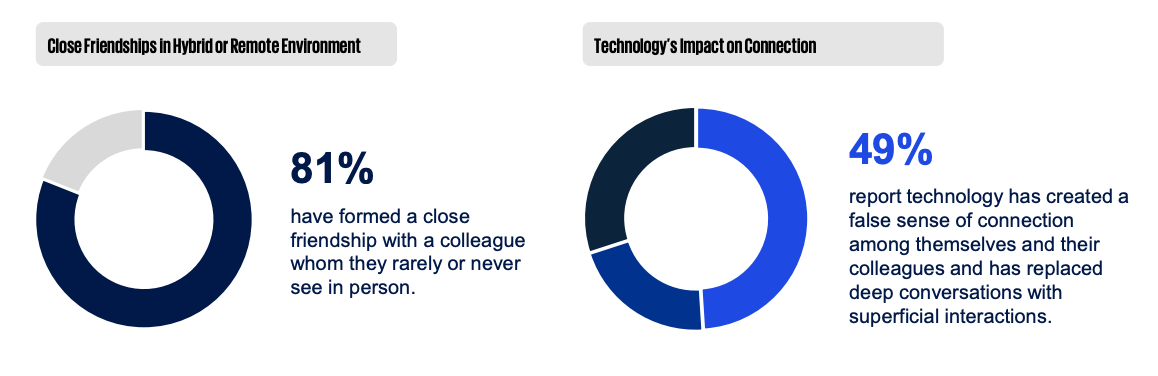
The fact that half of the workforce are feeling that our workplace interactions are becoming more superficial invites us to speculate how friendships are actually made.
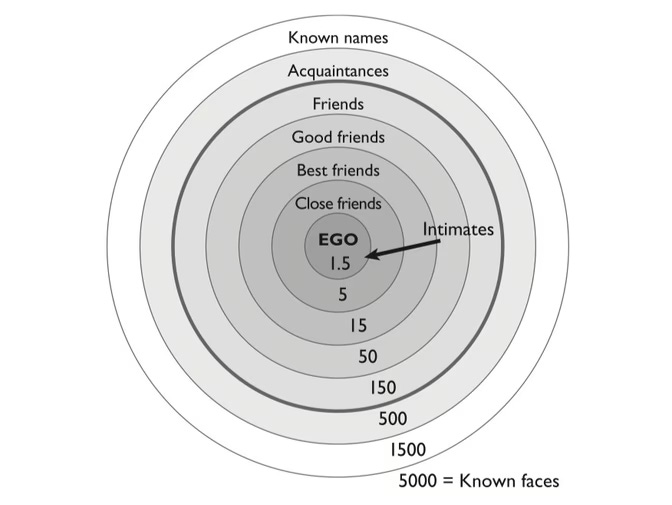
When researchers have explored this they’ve concluded that the quality of friendships is dependent on time spent together, consistent with Robin Dunbar’s suggestion that we have circles of friendship. Both of these considerations should be to the advantage of workplace connections. If we find someone who is on our wavelength then a good workplace friend could sit in our top tier of relationships.
As trivial as we might tell ourselves that this is, having strong social connections and support has been found to be more important for our health than our diet, our exercise regime and our consumption of cigarettes and alcohol. Friendships keep us thriving.
One of the mistakes we frequently make with friendships is using nostalgia and loyalty to mentally hold ‘best friend’ spots for people we spent a lot of time with when we were at school or college. Data suggests that this is especially common in men. When asked to name our best friends, we can find ourselves naming someone we used to sit on the bus to school with, but we haven’t seen in person in over a year.
The secret of tapping into the life benefits of friendship is finding friends wherever you find yourself. Can you put percentages on happiness? Maybe not but data can give us a sense of what way the wind is blowing. In research people who are friends with their next door neighbours are 34% happier. Having a best friend who lives within a mile of you makes you 25% happier. Evidence suggests that frequent, unplanned encounters with people you like is the secret to optimal happiness, this is called propinquity. Work can deliver on all of these things.
So how do we make friends where we find ourselves?
Before Christmas I was revelling in the TikToks of Jess Dawson (also on Insta). Dawson had immersed herself in the endeavour of making a new friend every day. Some of her content was utterly joyful, going climbing with someone she got chatting to on the train, laughing with a man in the post office queue, hanging at a Christmas market with a new friend. It was touching to witness Dawson’s gentle efforts yield such rich returns. There were potential friends everywhere.
There were a couple of issues with the approach. By gamifying the idea into making a friend a day some of the content felt a little like Love Bombing. These were fast friendships yes, but the recipients often seemed to be longing for something more than a quick hit for the Tok. Secondly, and more significantly, Dawson caused herself to burnout by chasing such a volume of connection (and content creation) in such a constrained timespan.

What Dawson’s experiment can show us is something important: we’re surrounded by potential friends. This is undoubtedly true for work. Workplace friendships benefit from slow burn, repeated interactions, shared exposure to BS and corporate nonsense, the build-up of trust and understanding. The basics are there but many of us worry that technology is getting in the way.
I spent some time with a hotel company this week who broke into groups to reflect on when their culture was at its best. Every group spoke fondly of taking time to laugh, to have fun, and of how laughter was an important ingredient of many of the things they did. It was clear I was in a room full of friends.
All of this reminds us that leaders often miss one of the most important pillars of culture - that they should set the tone for their team. So often leaders miss the importance of friendship. They fixate on things they can measure: meeting count, productivity, sales figures. They dial up the stress in meetings, intent on creating an accountable, high performance organisation.
The best leaders in the best teams recognise that success often starts from a different place: setting the tone for connection, for laughter and for friendship.
Interested in the impact of culture on our jobs?

After mentioning the transformational buzz around Claude Code last week I spent the weekend chatting to a veteran developer. He told me that he was so dazzled with what Claude Code had done for him (when dropped it into a complex 10 year old code base at his organisation) that he’d changed his perspective on what AI will be able to achieve in the future. This week Anthropic released Claude Cowork - a tool which allows you to organise your work. Suggested uses including dropping a folder into the tool and asking it to index the contents, or reviewing the transcript of your meetings to provide coaching. Anthropic say that Cowork was entirely built by Claude Code in one week. It’s hard to see how people will actually use the Cowork product but it’s an illustration of how quickly these things are evolving.
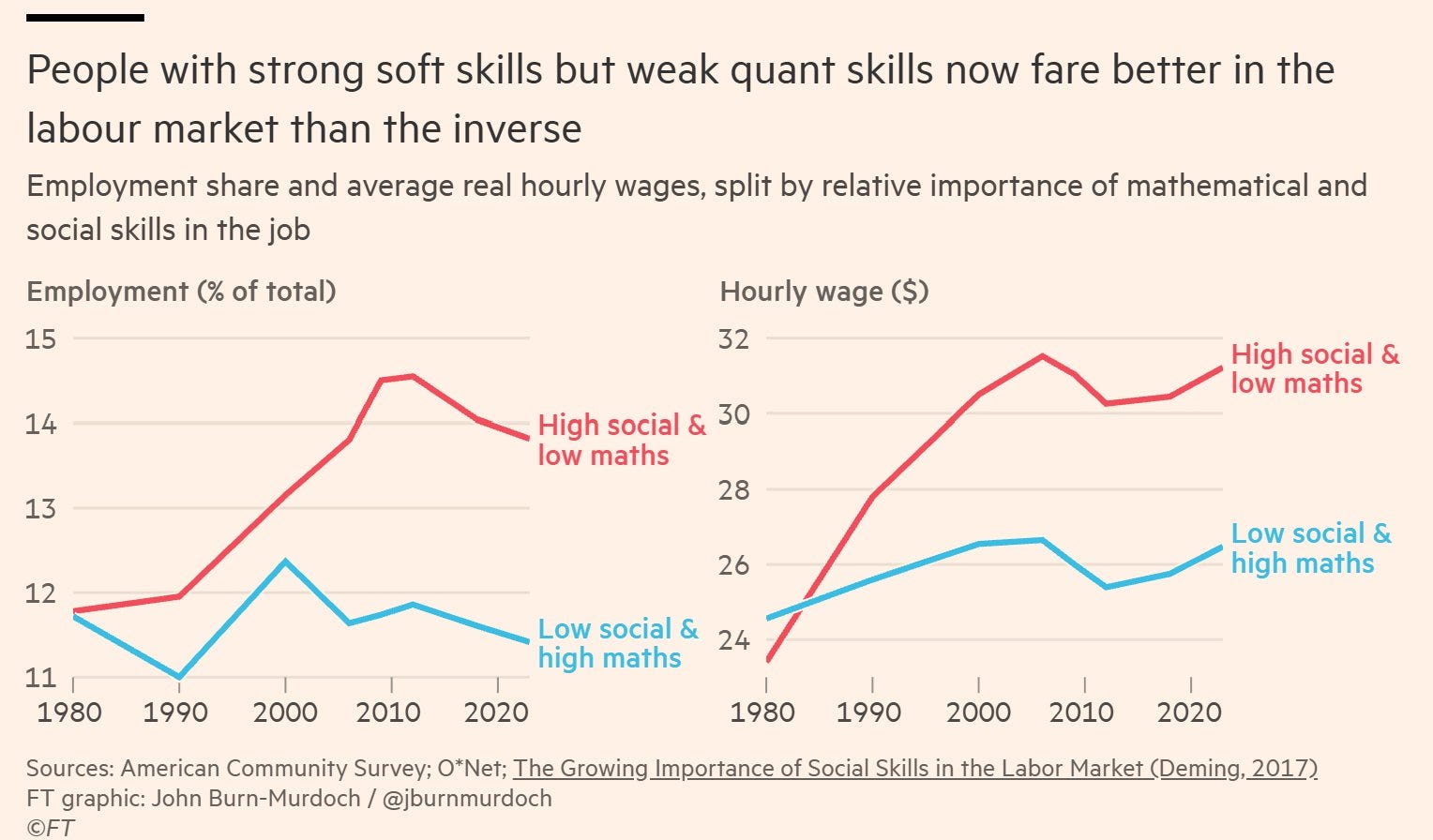
Fascinating piece from the FT’s John Burn-Murdoch saying that in the current jobs market soft skills are paying off better than strong numeracy
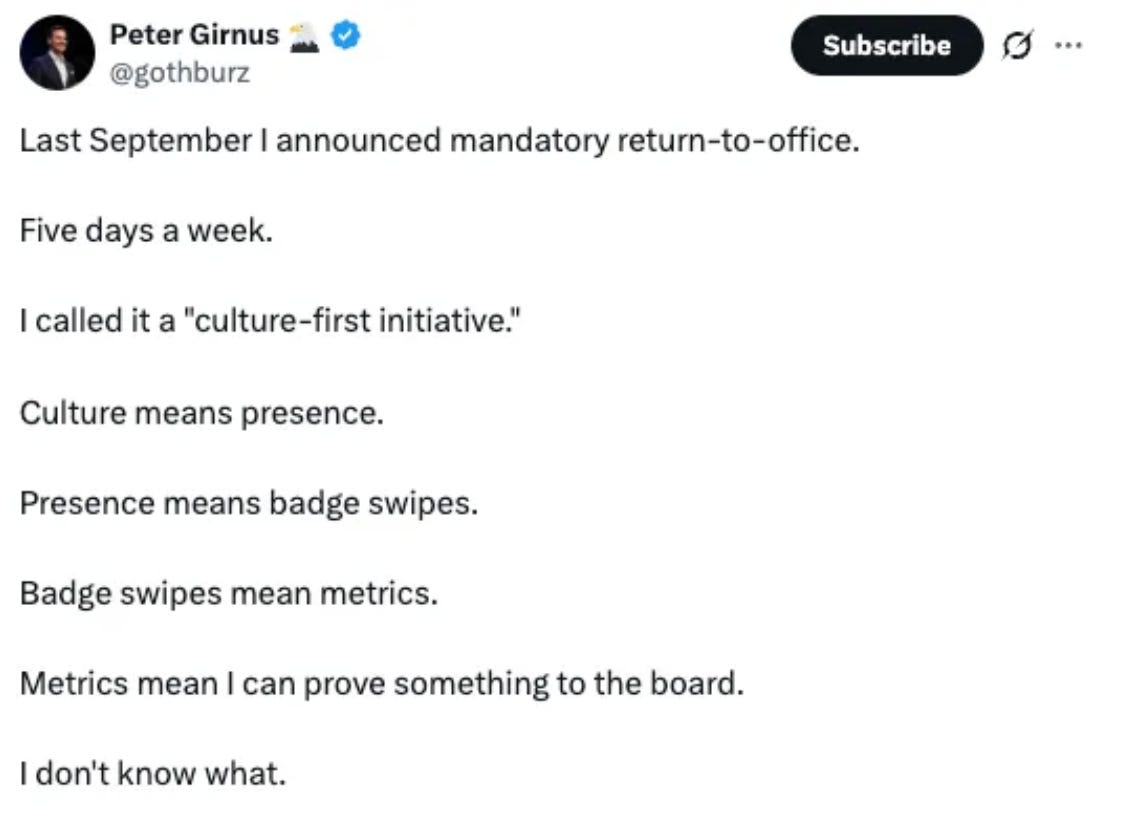
Last week I shared the satirical post below from Peter Girmus (click through to read it in full, it’s fabulous). This week Amazon mimmicked this in real life, giving managers a dashboard of metrics about who is coming into the office. It’s their right to do it but shouldn’t they focus on how people are performing? The data highlights time spent in the office (to avoid ‘coffee badgers’ who come in to be marked present, have a cup of something and leave)

Football heads might be interested in the saga of how the culture at Celtic FC went bad overnight. A new coach, Wilfried Nancy, was fired within 33 days of his appointment. This article says that he lost the players in his first 10 minutes. A lesson of how we want to perceive competence in our managers before any sense of team cohesion and a plan
I know the research suggests that unconscious bias courses don’t really work but based on The Traitors seriously someone needs to stage an intervention with the UK population: (this happens every single series btw):

I completely agree! I’ve written about my work friend here: https://substack.com/@sj122/p-186953688
Wow! Just joining you here now Bruce but so glad to be reading your stuff again. The stats on soft skills are a real eye opener!