

About a month ago I found myself on a panel alongside Jackie Cooper, the founder of Edelman’s Gen Z Lab. Edelman, a communication agency, found themselves creating the special department after hearing that clients were confounded on how to deal with the group, both as customers and as employees.
The Lab’s findings are worth checking out because both chime with what you might have thought but also challenge it. Empathising with context is a good foundation. Members of Gen Z have been shaped by recessions, the pandemic, geopolitical instability, not to mention financial insecurity and world changing technology.
Such constant change has led to them having what Jackie describes as a ‘visceral need for safety’ - that’s financial, social, cultural and even physical safety.
They respond to fear by asking questions and wanting to be heard, certainly something older generations often misread as entitlement or disrespect for hierarchy.
Politically, Gen Z is fragmented. Younger Gen Zs, especially boys/young men in the US, are leaning more conservative and are drawn to strong-man archetypes; older Gen Zs, shaped by Obama / BLM, are more idealistic about progressive politics. (The polarisation doesn’t feel as pronounced in the UK where the Greens are actually polling ahead with under 50s)
Understanding this generation is key to success for all of us in the next few years - I think you’ll love this discussion which you can listen to as a podcast below. You can also read the report here
Listen: website / Spotify / Apple
Thanks to Deliveroo for Work for sponsoring this week’s Make Work Better. (If you want to reach 145,000 workplace culture obsessives across Substack and LinkedIn get in touch)


Meetings consume three days of work per week: workers spend an average of 25 hours a week preparing for, participating in or following up on meetings according to new data from Zoom and Deloitte
70% of Brits say the rhythm of the week has changed in the last 3 years. Not just the end of ‘Friday pints’ but that the 9 to 5 has become the 5 to 9 as we’ve started living life earlier. Some good insight in this new report from The Guardian (thanks to David Wilding for pointing this one out)
Friday is the day when most people are able to carve out ‘me time’
More than 55% clock off early on Friday (home internet usage plummets between 3-5pm that day)
‘5 to 9’ has replaced the ‘9 to 5’ with 63% of the UK now saying they wake before 7am, 61% of Londoners are up earlier than three years ago
A different source (this time in the US), but similar findings: workers are clocking off 90 minutes earlier on Fridays than they used to in 2019
At the other end of the weekend, Adobe looked into the causes of the ‘Sunday Scaries’ with 82% of workers saying they experience some degree of angst about the workweek ahead. With remote workers its caused by lack of fulfilment
Haunting article from Slate of a handful of firms who are proactively pushing workers to engage with workplace wellness activities like yoga. Includes the line: ‘My workplace just decided to do a casual, team-wide weight loss competition’
The Guardian also reports that AI is set to replace 3 million jobs in the next ten years, while 2.3m new jobs will be created. Worst affected professions will be management consultancy and software development jobs
If you’re paying attention to friends who are looking for work it will be no surprise that ‘the job market is hell’ with AI written applications being rejected by AI powered algorithms
Employees are the most adept at AI are twice as likely to quit, so says research from Upwork. Workers are proving to be 40% more productive with AI tools, but there is a ‘productivity paradox’ where workers are getting more done but feel more disconnected from their colleagues. Workers report trusting AI more than their colleagues (similar to this research about student group chats last month)

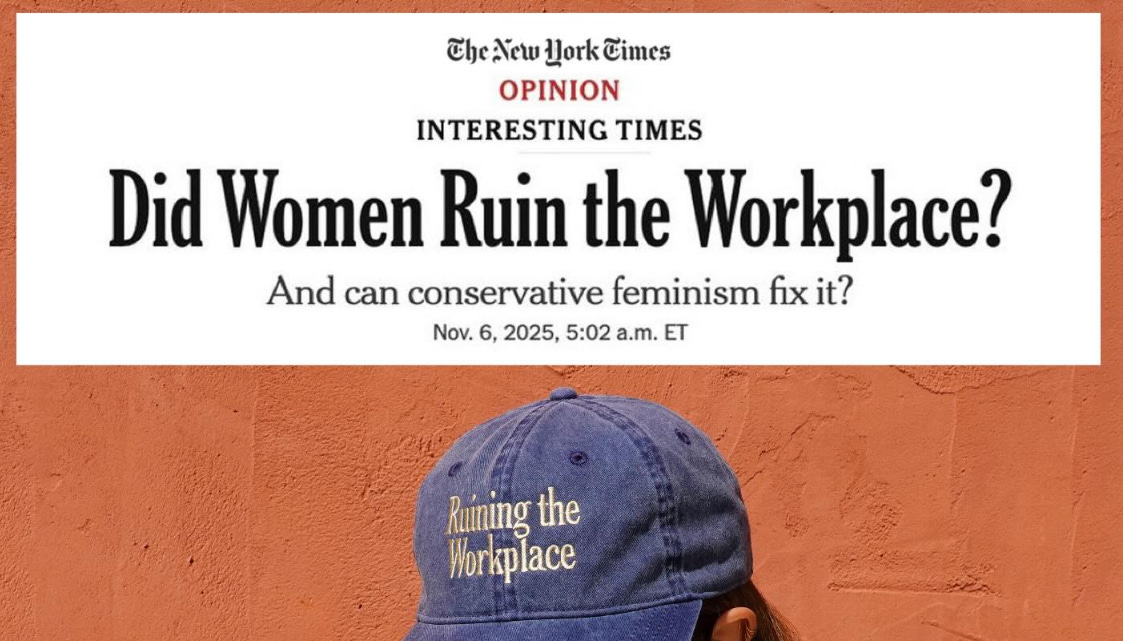
I’ve been losing more and more faith in the New York Times but this discussion entitled ‘Did Liberal Feminism Ruin the Workplace?’ was utterly execrable. The piece uses two female conservative voices to say that giving voice to women has ruined work, citing issues like MeToo. I share it partly because I loved the person who made merch to call out the BS of it all:
Very insightful