

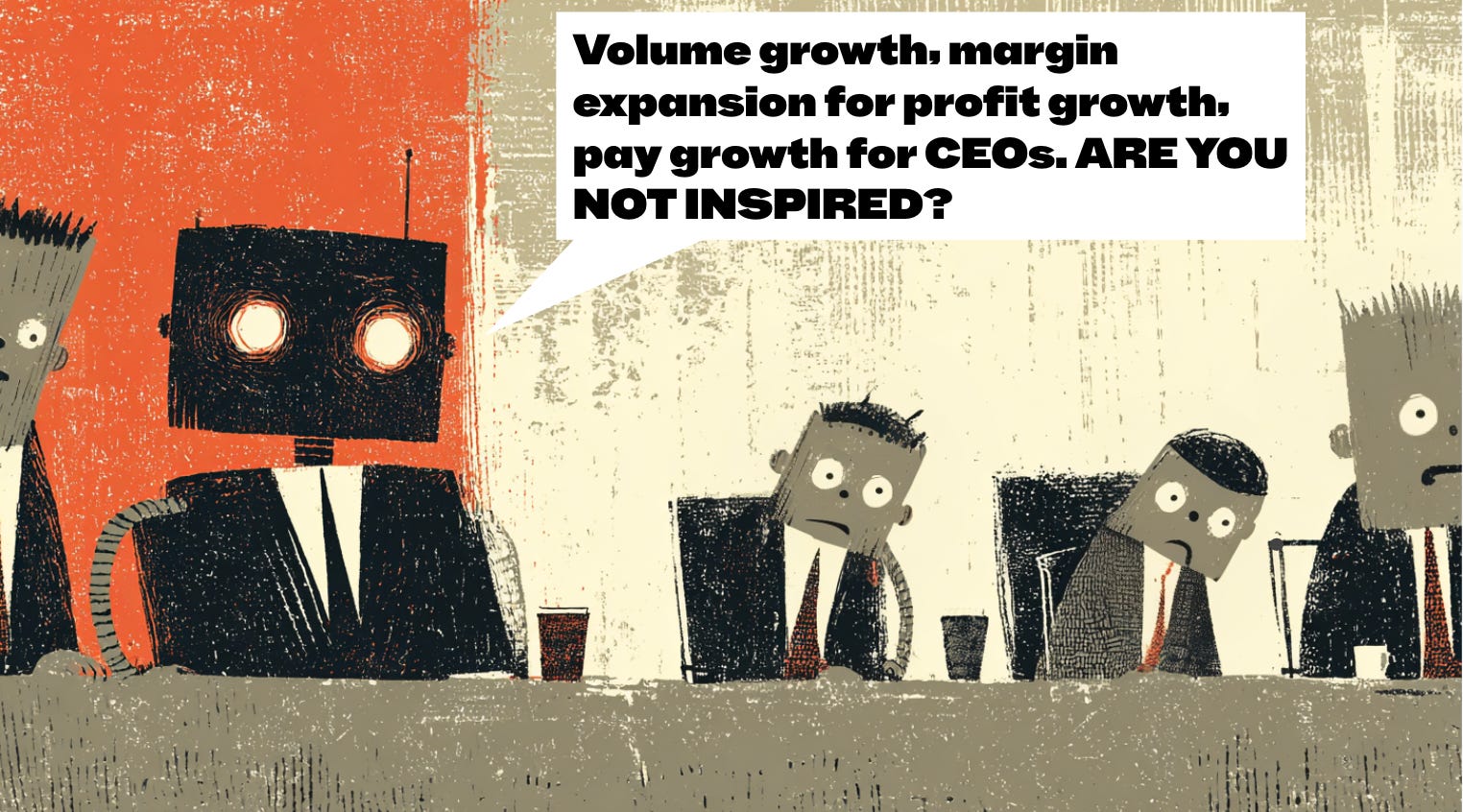
“Before saying hello I say: ‘Volume growth, positive mix, consistent growth margin expansion for profit growth in hard currency’” - this is Unilever’s CEO Fernando Fernandez’ dystopian attempt to implant his strategic priorities in his employees’ minds, as featured in this Bloomberg article. The article reports on attempts of senior leaders to dial up results; across earnings calls for the S&P 500 executives used the phrase ‘performance culture’ 633 times last year as they turned up the heat.
We’ve spoken previously about the danger of using opaque business jargon when it comes to communicating with employees, rather than assigning modelled behaviours or explaining what someone should actually do in their day-to-day role.
Imagine working at Unilever for Mr Fernandez. Maybe you’re a marketer selling Dove shower gel. You’re told to improve positive growth margin expansion (for profit growth in hard currency). What does that actually mean for you doing your job? Don’t you just blink, write it down and nod? How is this my life? I worked hard at school. Amongst senior bosses there’s an obsession with using strategic jargon to demand workers fall into lockstep. This stems largely from a profound anxiety: research suggests that the priorities for the top team aren’t top of mind for workers lower down their orgs.
In 2018 researchers at MIT found that only 28% of executives and middle managers could list their company’s strategic objectives. Top bosses get preoccupied that no one understands their priorities. But barking financial jargon at the frontline is a little like telling children to be happier, in truth improved results are achieved indirectly. We make businesses more successful by creating the conditions for success, not by ordering improvement.
It’s why the most important thing that these bosses can do is create high agency cultures, freeing people up to have impact in their own roles. I enjoyed reading the forthcoming book, Agency by Martin Seligman. Seligman makes one point emphatically, that human progress occurs, not when we have everyone following orders, but when you empower everyone to have an autonomy-imbued impact themselves.

I talked about it a little in the talk I shared last week. In that talk I mention how Ritz-Carlton gift agency to employees in the form of the discretion to spend $1000 to solve a customer problem. Or how Octopus Energy give their employees the autonomy to solve any customer’s problem on the first call (up to crediting someone’s entire bill). When you treat people like adults, explain the business to them and give them the tools to solve problems you don’t need to yell about margin expansion in hard currency. The performance takes care of itself.
Strong cultures create a sense of people being trusted not targeted with slogans. Whether it is opaque corporate values, or someone telling you that the strategic priority is margin expansion, next time you hear this chat should be a moment for reflection. Next time you hear these things ask yourself what would be a helpful alternative right now? What obstacle needs to be removed? The truth is that the most effective performance culture is high-agency culture in disguise.
(Also see below: the author of Empire of AI says the whole of the AI movement is a ‘political project [with the goal of] taking agency away from everyone’)
Sport extravaganza
If you’re a fan of observing culture in the wild there’s been some wonderful stimulus in the last week on the end of season wrap-ups on Arsenal, Pep Guardiola (and more):
Firstly former podcast guest Pippa Grange is one the main characters in the new series on Gareth Southgate’s culture transformation of the national football team in Dear England. The show’s dialogue is a little cheesy in places but the work of Grange and Owen Eastwood come across as the shining inspiration of the story. (Eastwood’s work is all about the players’ position in the timeline of historical players, but he’s not portrayed as a character in the drama). Listen to my discussions with Pippa: episode 1, episode 2.
I have no dog in the fight but I’ve loved scrolling through a lot of the Arsenal content this week. (‘I just love watching happy people,’ I’ve explained to half a dozen people who’ve asked me why). There have been some fabulous reads about the culture of together that Mikel Arteta built at the club. When he joined The Telegraph reported the team was full of cliques and he set about building a shared identity, symbolised by a sign saying ‘We x Me’ at the training ground.
The Athletic ran an extensive piece on the ending of the Pep Guardiola project at Manchester City. In one sequence the Spanish coach models his own fallibility telling his team to ignore a training exercise he’d been attempting, ‘Forget everything I just told you. All of it. It was nonsense. It doesn’t make sense.’

Wired reports that the culture at Facebook is ‘uniquely grim’. ‘I don’t know anyone having a good time,’ says one employee. The workforce has been told that they are being constantly tracked to train AI models (the implication being that it is to do their jobs). When one employee protested that their messages were being read, CTO Andrew ‘Boz’ Bosworth ‘belittled and berated’ them leading one Meta worker to say, ‘These billionaires can’t even feign empathy’.
Another former Facebook employee posts about his own ‘Squid Games’ like experience at the organisation: ‘There are no repercussions for unethical behaviour. I've seen managers and TLs throw others under the bus and get away with it.’ He adds that ‘The culture is extremely performative and focused on box ticking and optics. Everything is about perception.’
The issue of young people not in education, employment or training is a big and rising challenge for the UK. The number of ‘Neets’ just hit a million and it’s set to be a major political discussion of how to avoid a lost generation.
We’re all God’s creations but Standard Chartered wants ‘lower value human capital’ to know they’re going to be replaced by AI. He tried to wind this back when he got a savage response. Another sign of CEOs just being utterly out of touch with the realities of their employees.
Fascinating to see UK’s growth on a long-term chart. It explains so much of the realities of contemporary politics.
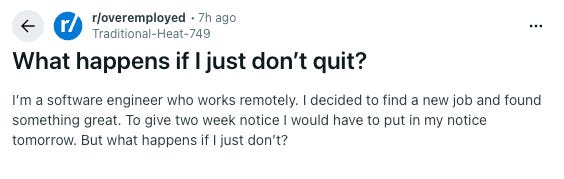
I have to admit a deep fascination for this sub Reddit dedicated to people doing multiple jobs:

If you’re an AI sceptic there’s plenty to feed your doubts this week:
Uber’s head of operations said it was proving increasing hard to justify AI costs inside the company. It comes a couple of months after the firm’s CEO said that hiring was being slowed to pay for AI spend.
Bubbling up: Axios reports one organisation ran up a half a billion dollar bill on AI tokens by not capping the usage of them by engineers. Perhaps unrelated, Amazon have ditched their AI code use leaderboards
“AI is a political project. The central feature of that political project is taking agency away from everyone”, so says Karen Hao, the author of Empire of AI, a book about OpenAI. Quite an astonishing comment that I’ve been thinking about for 24 hours since. She said it in the context of Tony Blair saying we societally need to submit to AI.
Your point about agency and autonomy is great! Some of our research is centered around self-determination theory, which argues that people perform their best (and tend to say) when autonomy is supported in their workplace. It's great to see examples of that in action here!
Toxic companies are all about slogans. And their slogans are creatively bankrupt. It's like a shitty high school pep rally.