


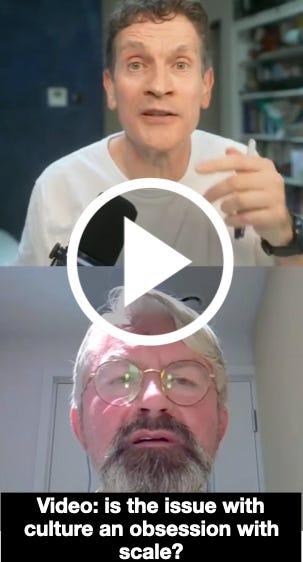
This week I had an enjoyable ding-dong of a discussion with Professor Rob Briner. (You can listen to it as a podcast below).
At one stage Rob says: ‘If you tell someone - whose favourite thing is organisational culture - and you tell them it’s not a very useful idea - they don’t like it.’ Well, I felt seen.
To be fair I’d already acknowledged that I agreed on what he was saying that behaviours are more important than culture. Also I’m more than a culture fan, I promise.
But it’s a sign that it’s an outstanding discussion. Rob’s key point was that the idea of culture is vague and subjective.
Rob says that culture is ‘a description. So if you want to change something, you don’t change the description of it, you change the cause of it.’ He says we should be specific about what we’re trying to do and why.
‘It’s easier to act your way to a new way of thinking than to think your way to a new way of acting,’ was the way that one management thinker, John Shook, expressed this in a famous study of the NUMMI car plant in Fremont, California in the 1980s. The notion that behaviours are hard to change and require much more deliberate action that changing slogans is easy to accept.
Rob Briner takes this further and explains how any of us should be thinking about bringing evidence to our work with teams. For me a key takeaway was a recognition that discussion about culture often seeks to be a short-cut to do behaviour changing work at scale across an organisation. A leader diagnoses that some employees aren’t behaving in an enterprising way, and they announce that henceforth the culture will be more entrepreneurial. In this regard the demand for a scaled solution gets in the way of us staging an effective intervention.
In truth the most effective organisations need to think about how they allow local decision making - unlocking local autonomy in their teams.
A wonderful discussion. Check it out on:
Rob asked me to share the following bio:
Rob Briner is Professor of Organisational Psychology (Queen Mary University of London) and a Research Director at Corporate Research Forum (rob@crforum.co.uk). He has been promoting Evidence-Based Practice in Management, HRM and Work Psychology for almost three decades. His recent research with Corporate Research Forum includes reports on Evidence-Based HR and how HR can more effectively drive organisational performance.
He also leads CRF’s Work Psychology Network which has produced reports summarising the best available and most practical work psychology theory and evidence around a range of topics including motivation and performance, assessing potential and behaviour change in organisations.
He has also produced a series of short posts on LinkedIn where he explores various popular ideas about behaviour at work (e.g., learning styles, psychological safety, growth mindset, happy-productive worker) and asks about each: Is that really a thing? That question is answered through a combination of critical thinking and using reviews of scientific evidence.
There are some good comments on the LinkedIn posts about the episode: here and here. (Feel free to connect there btw).
—Ad—-
Spend less time searching, more time driving results.
With over 3 trillion PDFs in circulation, teams struggle to find and act on information. Adobe Acrobat Studio transforms static documents into a connected workspace that helps teams extract insights, collaborate, and create high-impact content faster, all in one place.


The end of the World Cup always brings articles about the culture inside the different camps. While the going was good for England this video felt highly salient - a manager obsessed that team cohesion was the most essential ingredient for success. And it certainly looked to be lived out for a while, backed up videos suggesting the culture in Tuchel’s squad was great. But this longread in The Athletic (alternate link) highlights the challenges that were actually going on behind the scenes. Cath Bishop talks about the importance of team connection (in a very much before the Argentina game take).
Want to help with some research? A researcher at the University of Salford is trying to examine coercive control in the workplace. If you’ve experienced workplace abuse (or know someone who has) please complete this anonymous survey.
The importance of delivering Mattering to high performers as well as underachievers. High performers (who can be up to 400% more productive than their colleagues) often disengage if they feel invisible or micro-managed. (Alternate link). More about Mattering on the podcast.
US productivity stats are on the rise, flexible work and greater use of digital technology are being credited.
Helping the NEETS (young people not in education, employment or training)
I had a brilliant discussion this week with Shane McCracken director of “I’m a... Programme”. Shane runs brilliant discussions between school kids and scientists. Exposing them to jobs that might otherwise be invisible to them.
This exposure has a meaningful impact, Shane explained to me that pupils who have had 4 or more meaningful career discussions are 86% less likely to become NEET. In one chat a teacher pulled Shane aside and told him that a child who was selectively mute in class was happily typing away asking questions of a scientist.
I’m so inspired by the work of Shane and others helping reduce the challenges of the NEET generation. If your organisation is looking to fund social projects I’m sure he’d be keen to hear from you.
Zuckerberg used AI to target workers with medical conditions with redundancy.
Former podcast guest Jeremy Holt encodes the new Prime Minister’s speech to work out how much he uses the language of identity.
The UK CEO paygap has expanded again, bosses are now getting 130 times a worker’s average pay. We’ve covered extensively that followership is enhanced when employees see that the boss is ‘one of us’ - and that CEO pay gaps typically reduce this.
Research into chimps suggest that group bonds and mental health come from touch. Indeed, friendly touch prevents conflict. (I’ve had a podcast on this in the past).
Me chatting about the Living Wage campaign driving pride - even amongst the employees who aren’t the beneficiaries of it.
This TikTok account never fails to make me happy (also on IG).
Am I naive for believing that if enough of us stand up and call out poor behaviours, culture will change? It’s always easier to stay silent but surely there are enough of us out there who are willing to stand up and call poor behaviour out?