


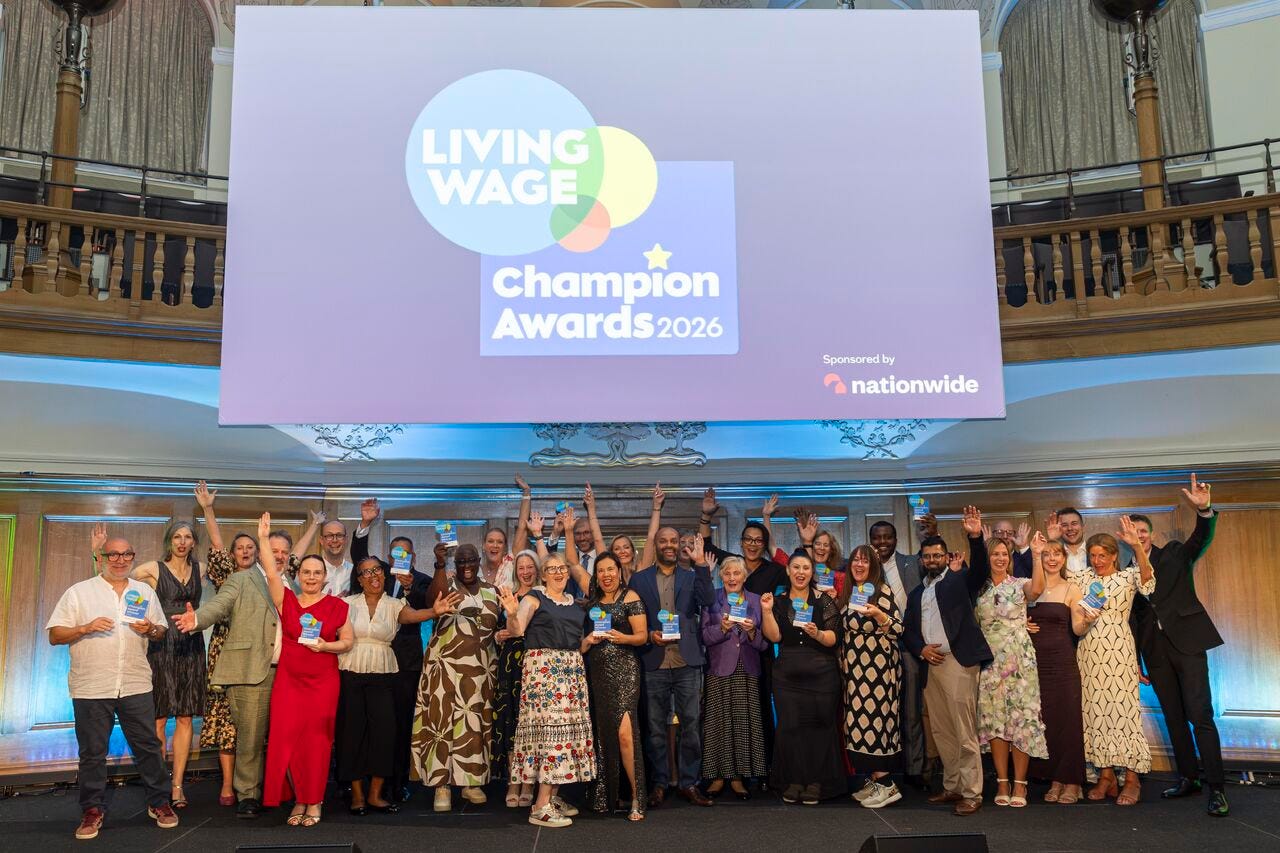
This week, on Tuesday 7th July, I was honoured to host the Living Wage Awards in Westminster. The Living Wage Foundation invited me to play a part after I posted about their campaign in 2025.
Last year, in preparation for a talk to the top 100 leaders in the retail sector at the Retail Trust I had spent a couple of hours talking to members of the Foundation to understand why the retail are one of the slowest adopters of the Living Wage.
There were lessons from the awards night that sectors like retail could learn from. One message that came across from the winners was the idea of the Living Wage as a business strategy - firms who signed up saw lower quit rates, higher employee loyalty and happier customers.
Chancellor Rachel Reeves opened the night after a short film celebrating the origin of the Living Wage Foundation. In 2003 low paid workers came together to send campaigners to HSBC’s annual general meeting. The campaign gained momentum when cleaner, Abdul Durrant, took the floor at the AGM and addressed the bank’s CEO:
‘We work in the same office but live in different worlds. Let me tell you what it’s like to work on £4.50 an hour and bring up 6 children.’
The intervention was widely covered in the media, and within eighteen months the bank - as well as and neighbouring financial institutions - had raised the pay of their cleaners.
It was a springboard to the movement that has now signed up more than 16,000 accredited employers and has put more than £4.2 billion in the pockets of low paid workers. This stuff really matters, MIT Professor Zeynep Ton says that an extra couple of pounds per hour impacts mental and physical health in the workers who receive it: ‘It’s the difference between being able to sleep and not being able to sleep’. When I was a child my mom (we say mom, not mum in Birmingham) worked three jobs to keep the household going, I know first hand the impact that a decent hourly rate has on living standards.
The most inspiring part of the evening was that alongside people who have dedicated their lives to campaigning for fair pay, several workers took to the stage. Workers who had spoken up to their employers, cleaners had written notes to big bosses. Gentle people who had used their voices, risked everything for a better life.
Big winners were Barnet Council, Uniqlo (yes - a retail business taking a step forwards!), Department of Business and Trade, Linklaters, Just Helpers, Ealing Council, Upward Frog, the Manchester Action Group, Compass Wellbeing, Siemens, Cleanology and the campaign for Making London a Living Wage City. Well done to the winners - I’m inspired by all of them.
More about the Living Wage Foundation.
Shared identity amidst diversity
How do you build a shared identity amongst the people of the most diverse city in the world? Zohran Mamdani's Knicks victory speech was an elite use of identity leadership. With the New York Knicks down 20 points in the last quarter of game 4 of the NBA playoffs, the odds makers 'gave the Knicks a 99.6% chance of losing the game'.
'There is one thing that the pundits don't get about this team, that they just don't get about this city.'
'It is in that 0.4% that we go to work. It is in that 0.4 percent that we find a way, we win'.
In the full speech he articulates what you might call the New York state of mind. 'What is New York if not your back against the wall. A dream that feels just out of reach? What is not New York but 99.6% of the world stacked against you. And who are New Yorkers if not people who hear those odds and smile.'
There are lots of lessons from sport around us in the summer time. The wonderful thing about - say - the World Cup is that you're reminded that the people of every nation on earth when asked say that they are the best country on earth. In turn Mamdani here is reminding New Yorkers that they are citizens of the greatest city. Why? Because they never give up. This is something every team leader can learn from.
A masterclass of communication.
—Ad—-

Up to 40% productivity is lost to fragmented tools and constant context switching. Adobe Acrobat Studio brings documents, collaboration, and creation together in one place. This allows teams to plan, review, and communicate faster, with fewer tools and stronger alignment. See how teams work together.


This interview with Pixar founder Ed Catmull unearths a lot of new content about the studio’s approach to creativity. (For example Steve Jobs fired two board directors who only agreed with him, because there was no point of having them there. And also the Pixar Brains Trust used to stop senior people speaking for the first ten minutes to allow other people to speak without trying to please bosses.)
If you like combining your World Cup viewing with some couch psychology then this interview with penalty expert Geir Jordet (I’ve mentioned him before) is a great exploration of how to embed psychological safety. Damian Hughes (former podcast guest) also explains how the England team developed their buddy system for penalty takers.
For people interested in culture or enjoying their lives, go to work in a private-equity owned business is just about the biggest red flag of misery ahead. Run for the hills. The Guardian did a nice explainer for the people who aren’t sure what the PE business model normally looks like (and why it often leaves culture in tatters).
Former Health Secretary Wes Streeting wrote an interesting piece about the culture in the NHS, calling out the fact that at the recent review of Nottingham maternity services (where 520 mothers and babies suffered potentially avoidable injuries or loss of life) many senior leaders refused to co-operate with the inquiry. While he suggests that a forthcoming ‘Hillborough Law’ will mandate candour in public office (with a two year jail sentence as the threat) it begs questions about how such cultures could be changed without a stick.
We’re far more accepting of CEO pay-gaps when we still feel that we share the same identity with the boss says new research.
I must be a weirdo but I loved this article about how happy rat-catchers are in their jobs. (Why? Massive amounts of agency, constant thinking about different challenges and lots of problem solving). The rat part would be an issue for me.
Germany’s leader has ordered a crackdown on their ‘sicknote culture’. The country has an average of 15 sick days per year and he says they won’t accept phoning it in any more.