

If you’re reading this, then like me you’re probably always looking for insight of how to make work better. If that’s you I can strongly recommend getting a copy of the The Happiness Dividend, the new report from Reward Gateway.
Opening with the context that half of all employees are unhappy at work right now, the report sets out the case for culture. Big stand out data points for me were:
Happier employees are 10-12% more productive
Happier employees are 30% less likely to leave their jobs in the next year
Improvements in employee happiness are linked to 18% higher productivity
It’s a great crib sheet of research of the case for the defence - if you’re looking to win over your boss this is the attachment to send them.

You possibly saw the case this week of the Wall Street law firm who had to apologise because its legal filing was full of hallucinations. I find these things hard to understand, as it’s so easy to ask for citations and to check, but The Guardian reports that the ubiquity of AI work slop is actually making many jobs harder
I know someone who in his first week at Meta was told ‘presume someone is watching everything you do, and listening to everything you say’. Now they are:
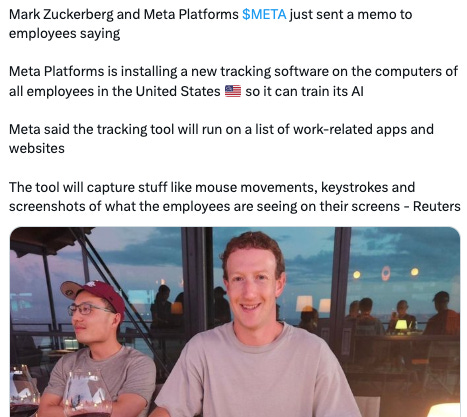
When Meta employees asked if there was a way they could opt out of a tracking system that could read their personal Gmail, health and banking details and private web usage they were told ‘No there is no opt out on your work provided laptop’. The company also told employees that they plan to implement 10% layoffs in the coming months and you can understand some degree of caution of not wanting to rock the boat in a choppy job market. (Worth saying that European laws will prevent a lot of this happening to EU and UK employees, where monitoring of laptops is allowed but can’t be excessive, but it speaks to the attitudes of Zuckerberg’s organisation).
Couple of cracking reads from The Atlantic on the AI debate. ‘Am I coal, or am I a horse?’ Firstly it allows you to work out if your job is going to be wiped out by the machines.[Free archive version]. It mentions Jevons paradox that we’ve discussed before: when technological improvements that increase the efficiency of something lead to a rise in total consumption of that resource
Then some push back on the idea that young people are losing their jobs to AI [Free archive version]. ‘Since the release of ChatGPT, recent graduates in sectors with more AI usage have experienced slightly better employment outcomes than they did prior to its release,’ it suggests. The bad job market is cyclical, not down to tech
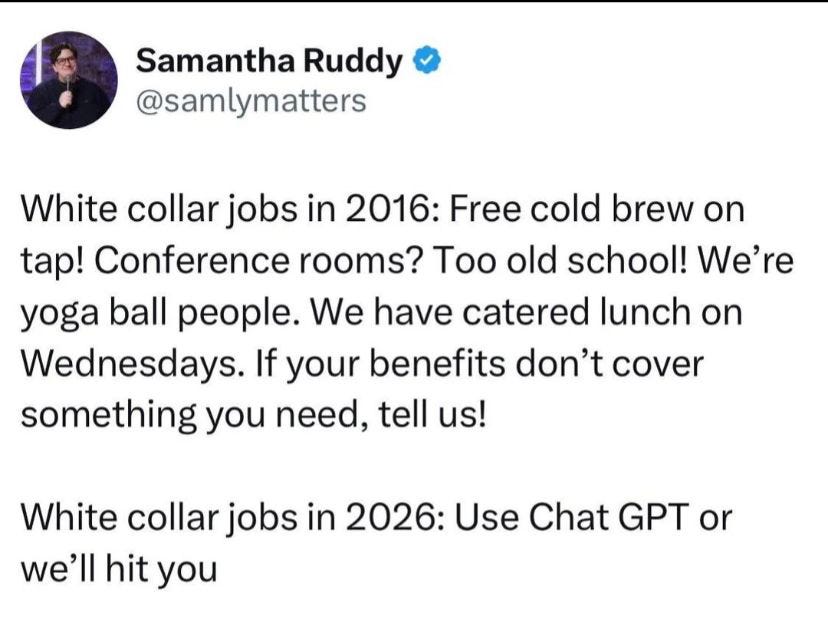
Did unhappiness at work increase or decrease with AI?
The 50% figure lands. But the more revealing number is not in the report: what do the leaders of those unhappy employees believe the figure to be?
In my experience, considerably lower. Not because they don't care, but because the signals reaching them are unreliable. What travels upward through most organisations is not what people actually think. It is what people calculate is safe to say. Honest information about how things feel travels poorly toward the top.
This is what makes the wellbeing investment case harder to act on than it looks. A leader who doesn't know the real scale cannot calibrate their response to it. And the reason they don't know is not a data gap. It is a communication gap.
The harder question behind this report is not what leaders should do about unhappiness. It is why they are consistently the last to know, and what in the way organisations communicate upward makes that the structural default.