


Earlier this year I was really taken with a LinkedIn post by Rob Briner, saying that for as much as we talk about psychological safety 'we don't know much about how to increase it' and 'we don't know much about the causes and effects of it'. Rob is a professor of organisational psychology at Queen Mary University of London, specialising in evidence-led interventions. He plays the role of a weary umpire when he hears people casually pronouncing on the cure for burnout, or other workplace related issues.
There was a great debate in the comments of his post, where Alex Haslam suggested that in fact there was plenty of evidence that group identity (a sense of We-ness) was the foundation for psychological safety. When we feel part of something meaningful, it unlocks that trust and ability to communicate without fear.
Alex cited research by Katrien Fransen, professor at which found evidence of identity leadership building psychological safety (or causing burnout in its absence). Thinking back to candid teams I’ve been part of this notion certainly passed the sniff test and reading Katrien's papers delivered a real penny drop moment for me.
The vital part of the insight is that is delivers a path to building better team dynamics that is clear to reproduce. I called her up to talk about her research:
Listen: website / Spotify / Apple
Papers:
Last month the Welsh Government published the first report into their experiment with minimum basic incomes. MBI is an idea that we’ll hear a lot about in the next few years as governments wrestle with the second order effects of AI led automation.
When your Uber driver (or lawyer) is displaced by a bot, governments might need to provide a livelihood to people to enable them to survive. There’s a line of thinking that suggests that in the abundance created by automation, this should be more than subsistence (both for moral and economic reasons).
In the Welsh trial participants were ‘care leavers’ aged 18 or over. These care leavers were individuals who had spent time in local authority care between the age of 14 and 16. The payments were roughly inline with the Real Living Wage given £1800 (£1290/$1862 after tax) each month for two years. Life outcomes have typically been difficult for these individuals so it was felt that they were worthy place to start.
Participants initially hadn’t anticipated working but quickly realised their livelihoods would be enhanced by topping up their income. Themes emerge that the payment helped individuals build a life with fewer concerns - young people described reduced anxiety, greater confidence, and a sense of being able to participate in ordinary life on equal terms with their peers. One participant put it plainly: ‘Before the money, I felt very restricted in what I could do. During the money, I was able to do what I wanted and live my life the way I wanted. It definitely opened my eyes to the fact that I was a lot more competent than I thought I was.’
The housing findings deserve particular attention. The money helped. During the pilot, young people could afford better accommodation, move away from unsafe situations, and achieve a degree of stability most hadn't previously experienced. When the payments stopped, some ended up in emergency accommodation. The report is honest about this: the pilot delayed housing problems for many people rather than resolving them. This is probably more a reflection of systemic failures in housing. While the 2 years of payments have now ended the study will continue until 2027.

===ad===
The Experience Your Team Didn’t Know It Was Missing!

At artspace we specialise in using the power of art to invigorate your team through unique, creative workshops. Our art psychotherapists create bespoke, transformational spaces, unlocking creativity, connection and a whole new way of seeing things. No art skills required. Curious to try something different? We’d love to chat – hello@artspaceartherapy.co.uk or visit artspaceartherapy.co.uk.
A week that brings Scott Seiss back is a good week:

The headline that ‘workplace attendance’ is at record post-Covid levels might prick your ears up, but it’s only just gone over 40% - this isn’t a 5-day office story
Apologies, I’m as weary of the AI & jobs articles as anyone but several items follow:
‘Work, out of reach’ - the next lecture on work and AI by economist Daniel Susskind is great watch. He reflects on the talk of skills mismatches and the short and long-term impact of this
The New York Times asks a similar question, just how bad is the AI jobs apocalypse going to be? (‘The risk is real. Given the upheaval we may soon be facing, it would be nice if we had a president capable of leading a thoughtful national conversation about where A.I. is taking us.’) [GIFT LINK]
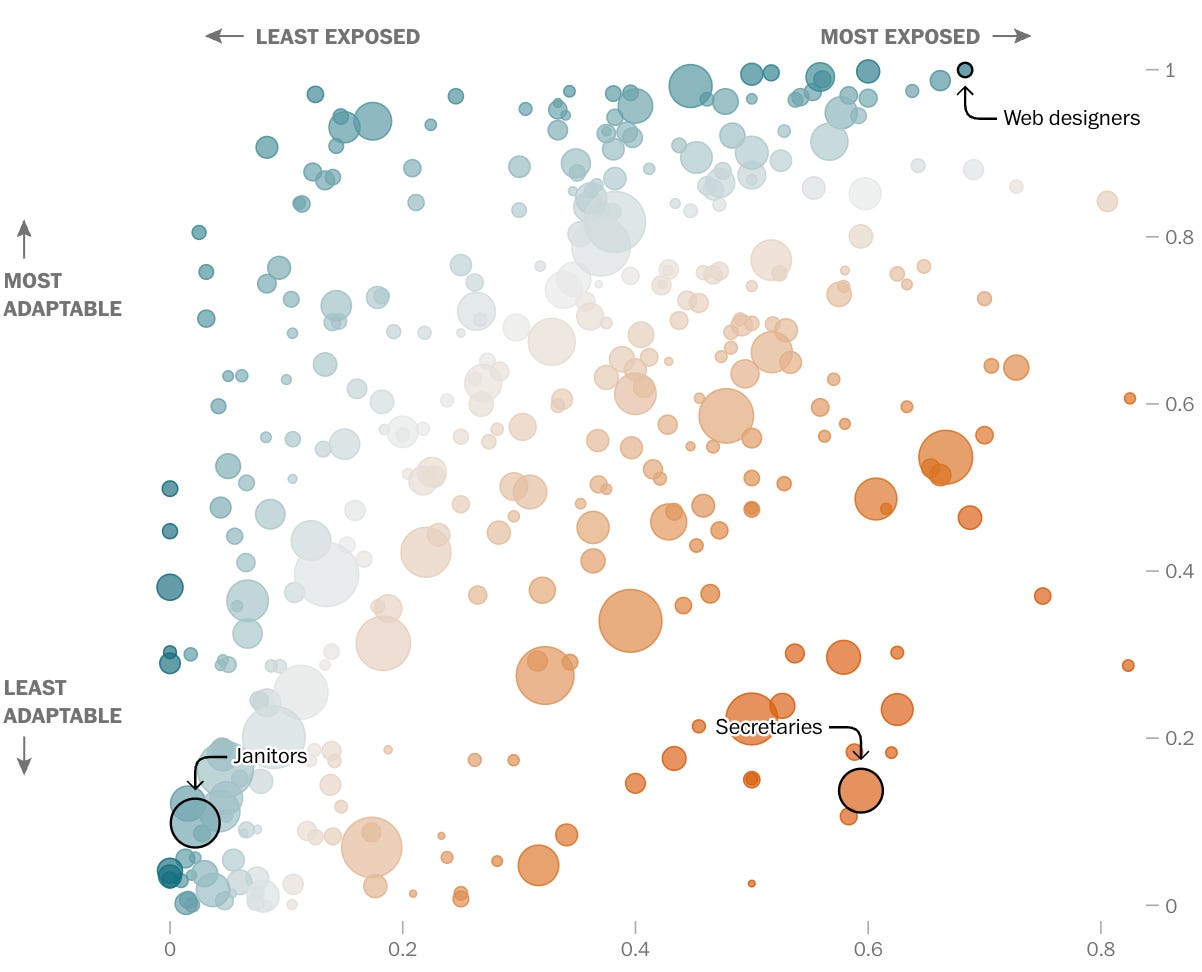
The Washington Post produces an infographic that considers which roles are at risk, but are also adaptable [GIFT LINK]
HBR says right now AI job layoffs are about the potential of the technology, not what it’s actually delivering
I don’t really understand football but I did like this story about David Luiz

Great post as usual Bruce. I think the main thing most organisations get wrong is thinking psychological safety is something that you can create: when the reality is it’s something you have to earn. It’s very difficult to fake. And most organisations don’t care enough to prioritise it.
What I find fascinating about the psychological safety convo in a work context is the leap to treating safety as a team/collective attribute without considering it first on an individual level. For team PS interventions to work, we must start with each person's safety baseline and capacity to increase that.