

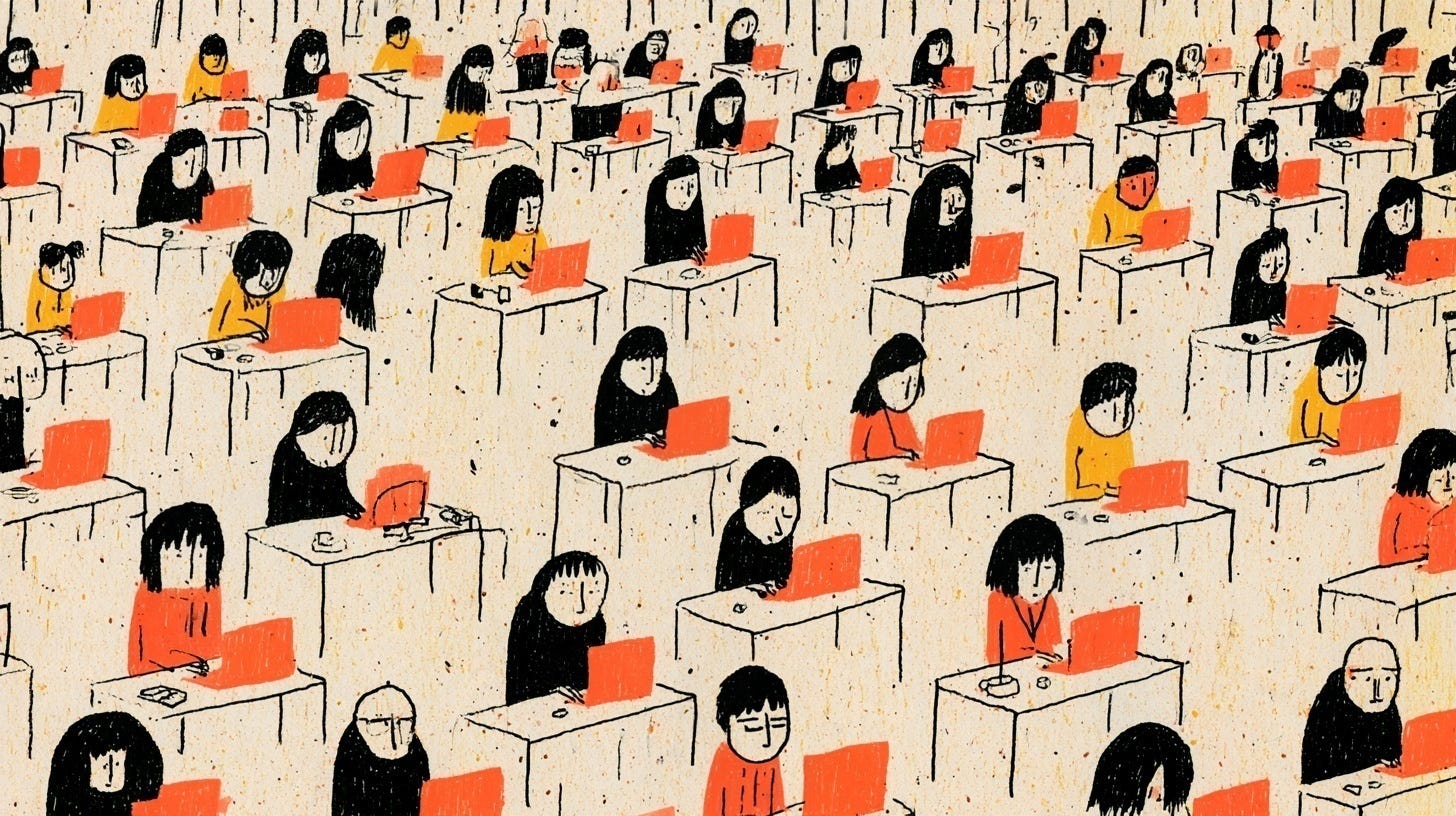
Has hybrid working been a disaster? Should we stop pretending and get back to the office? That is the claim of a new book by Natalia Emanuel and Emma Harrington.
The authors of In-Person tell us that: remote work is qualitatively worse:
‘Mentorship falters, learning slows, and the quality of our work suffers. Innovation stalls, and we drift further from one another and from the mission that once animated us.’
They claim that ‘we have sleepwalked into a new normal that will make us less creative, more isolated, and ultimately less fulfilled.’ They tell us that remote work makes us lonelier, it ‘degrades mental health’ and it is an existential risk for the economy.
This is a huge topic for readers of this newsletter. Frequently readers tell me how keen they are to get their team back to the office. In this exploration I think it is important to follow the data. It’s clear that some degree of in-person work is helpful for teams, but let’s honestly calculate how much.
Not only did I hate the book - in pursuing its hypothesis the argument is partial and at times borders on disingenuous - but I’m also a little suspicious of it. I can’t escape the fact that the authors were funded to write the book by the neo-conservative Smith Richardson Foundation. The Foundation makes it clear that it gives book grants ‘to create an economic climate hospitable to entrepreneurship and growth’. Nothing reasserts the power of capital over labour more than demanding submission about how the work gets done.
Maybe I’m misguided, but I can’t help but feel that a book that was even-handed about the data wouldn’t have got the think tank funding. (I’m not suggesting that this was the program they were on but its grant to write a book seems to be a similar funding model).
But I wanted to examine the book’s arguments in good faith - so below you’ll find some of their key data points. If you prefer to listen here’s my interview with Natalia Emanuel where I raise many of these topics (as well as the Smith Richardson Foundation funding):
Listen: website / Spotify / Apple.
Point 1: Remote work produces high quantity work but lowers quality
The authors evaluate analysts producing earnings forecasts, saying that those produced in person were 15% more accurate. (It’s worth saying that the same research said that remote work saw a 46% increase in timeliness - remote reports were produced much quicker). This was the author’s own work and hasn’t yet been peer reviewed.
Point 2: Creativity drops with remote work
One study that looked at brainstorming over video found that it produced 14% fewer ideas - and the ideas were rated less creative. Eye-tracking suggested that staring at the screen narrows thinking. Microsoft found that when staff went remote, communication networks shrank and became more siloed. Indian firm HCL Technologies found that remote workers submitted as many submissions to an ideas portal, but they weren’t rated as highly.
Point 3: Remote work is bad for mental health
The authors claims that after 2020, people in jobs that can be done remotely became 9–12% more likely to report depressive symptoms.
Professor Nick Bloom has commented extensively on this research - saying that it is a ‘a gross misunderstanding of the data’, suggesting that people with mental health issues might retreat to WFH as a coping mechanism - rather than it causing their problems. Indeed Bloom thinks remote working has been a huge benefit to most people’s mental health challenges.
Point 4: Mentoring fails at a distance
This is an interesting data point, albeit based on a single study of one firm. In one firm engineers whose team sat together in one building got 22% more code-review comments than teams split across two buildings. When offices closed for Covid, the drop in feedback was steepest for the teams that had sat together. Over time, engineers who got less feedback wrote buggier code.
Point 5: The book discounts the lived experience of workers
One worker with a two-hour commute and a young family is pushed aside because his experience isn’t typical. Meanwhile the authors pick stories that suit their narrative. We’re told that Daniel Kahneman and Amos Tversky had a wonderful relationship in person but fell out when they were apart. In truth Michael Lewis’s The Undoing Project, documents that their fall out was largely based on resentment over credit and recognition - not their WFH disagreements.
Point 6: ‘No iconic inventions were made on Zoom’
The authors claim that nothing good was ever invented remotely, ignoring their own story of Concorde’s black-box code being programmed by home-workers.
Conclusion
What is interesting is that I feel hybrid work addresses a lot of these things. Getting the best value out of in-office time requires co-ordination and collaboration. The authors report a Turkish call centre that found that bringing fully remote teams together once a month raised productivity and lowered quit rates. In another study sales reps given paid-for in-person lunches with colleagues sold 15% more. (Their firm got $1.3m in extra revenue for under $15,000 outlay).
If you’re interested the podcast is great place to explore your own thinking. Let me know your thoughts in the comments.
Listen: website / Spotify / Apple.

Intriguing post suggesting that Amazon’s unique meeting culture (where colleagues bring along a proposals in the shape of long-form documents that are read in silence) has been damaged by the arrival of AI-slop. ‘Two minutes in… it was blindly obvious that he was reading it for the first time… Because the presenter was the most senior person there, nobody was brave enough to speak up.’
Meanwhile Microsoft leaders are worried about a ‘doom loop’ of low quality internal documents being created. 90% of executives say that they’ve yet to see productivity gains at their organisation; while a third of leaders say there has been an AI incident that led to an issue like ‘data loss, financial damage or operational disruption’.
Getting team members involved in defining the culture of a team helped to embed it: participants ‘reported stronger team cohesion… and described the intervention as contributing to greater accountability, buy-in and team unity’.
Zoom’s announcement that it was going to capture out-of-meeting hallway conversations and make their contents searchable made me wince. It sounds like it’s an integration with DTEN hardware devices. Let’s hope these things remain optional.
Important HR training video
Icebreaker gone wild: BUPA’s Australian head of HR admitted to sneaking items through the self-check out without paying. She didn’t last the week.