

A couple of years ago a piece of work was published that ended up getting headlines across the world. The academic paper found no evidence that workplace wellness programmes.
That meditation app, that burnout webinar, that resilience workshop - they had no impact on workers’ experience of their jobs. It was such a revealing pulling back of the curtain that it raised questions about what was really going on at work. Were organisations using wellness initiatives as reputational alibis, giving them deniability when workers inevitably became exhausted by an unsustainable pace of work?
The researcher behind the work, Will Fleming, is fast becoming one of the most exciting workplace thinkers around. He works as part of Jan Emmanuel De Neve’s Wellbeing Research Centre at Oxford University. After wellbeing programmes his latest research took a look at the phenomenon of compressed working hours - where an employee has a remixed working schedule such as performing five days’ work in four days. This approach is often seen as one of the methods of shifting to a four-day week. In fact, Fleming found that it ended up with women feeling more exhausted than a five-day week.
I chatted to Fleming for this week’s podcast. He talks about new research still in the field exploring the impact of AI chatbots on our wellbeing. Spoiler alert: these are not the droids you are looking for if you want to make people’s lives better. AI seems to be merely the latest step of intensifying our experience of work.
It raises the question of what enlightened organisations should be doing. How do we improve the wellbeing of our employees? People strategy needs to sit at the centre of how the business runs, not treated as tactical add-ons.
The answer is tackling the systemic structures of work, rather than looking for easy solutions. How do we train managers to avoid an urgent framing of challenges? How do we shift from thinking the solution to everything is a meeting? How do we reinvent the way we do work, rather than just add more and more to our calendars?
We should celebrate the important role that the likes of Will Fleming are fulfilling. Without the willingness of outside voices challenging the quiet norms of work we end up with burned out workers having to smile as they’re offered a twelve-month subscription to a meditation app.
Listen: Apple / Spotify / website. A full transcript is on the website.
Check out Will Fleming’s latest hits:
Reduce or compress? Evaluating the 4 Day Week vs Compressed working hours
Are wellness programs examples of depolicised labour reform?

More on the power of a balanced model of work: fully remote workers who were brought together once a month were more productive and less likely to quit that their fully remote colleagues.
Building rituals for your team: Previous podcast guest Kursat Ozenc is a product designer who has brought the practice of building workplace rituals to his classes at Stanford University. He’s just published a new website that helps you create rituals for your own team - detailing which firms use each approach. Give it a go!
Are you a worrier? Chill out a little, 91.4% of anxious thoughts never come to pass.
I love Dani Payne’s content about young people in the workforce on TikTok, her day job is at the Social Market Foundation. They have released a new report which highlights the importance of first jobs in life outcomes. It urges bosses to create a first jobs pathway into their organisation.
Post-Midterms Switcheroo: get ready for a reverse ferret from the worst bosses in the world. Make sure you see through the lies of people who suddenly seem to remember their principles in a post MAGA world.
If comparison is the thief of joy, do you really want to know what your co-workers earn? The Equality and Human Rights Commission wants to ensure that workers will be able to request detailed information about the pay, bonuses and other perks received by their co-workers. There seem to be a lot of upsides, gender pay transparency saw a 19% reduction in the gender-pay gap. Good opinion piece by Andre Spicer.
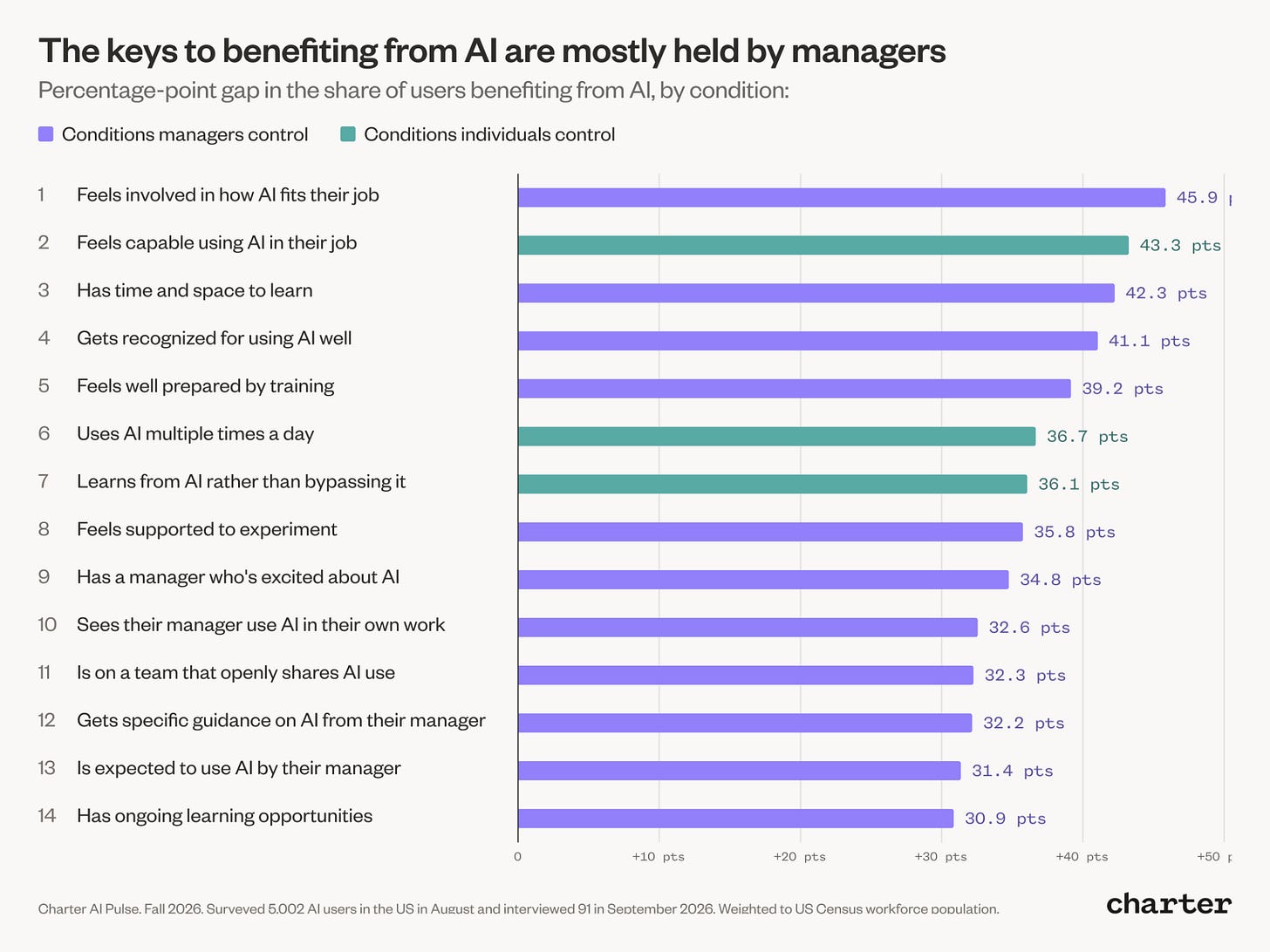
Charter Works’s analysis of the real impact of AI inside organisations is hugely valuable research. The research is US-only but its independent origin means it’s the first insight we have that doesn’t come with a sponsor’s agenda. 42.7% of AI users say AI is making their work and their life at least somewhat better. Around a quarter of that group (10.5% of AI users) say AI is making their work and life much better.
Curiosity and self-directed learning has been the biggest personal differentiator so far: interestingly most of these people got to this state on their own, it wasn’t workplace training that helped them.
Workers are crying out for proper training… but a great manager is the most important factor:
Successful PR pitch of the week, the Hackney co-working space that doubles as a sex club
